
Move It Monday September 14 Tonya Tittle– see video here for segment and more info.
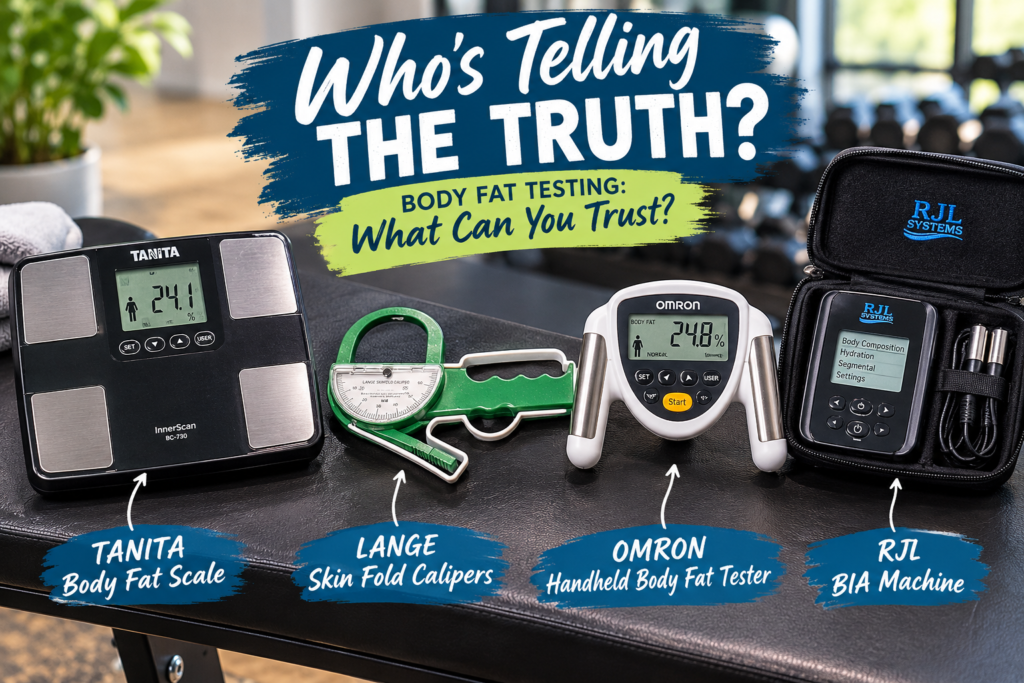
We took to behind the News desk with this topic. We demystified body composition testing by comparing four real tools side by side — a clinical-grade BIA system, skinfold calipers, an at-home handheld device, and a consumer Tanita BIA bathroom scale.
Back in graduate school, my research project was comparing skinfold calipers against Bia Machine (bioelectrical analysis) and Hydrostatic weighing (underwater). It went on to be published and presented at a conference. In this news segment we explain what’s actually accurate, what’s a good trend tool, and what you should trust when you are tracking your own progress. FYI..the results of my grad research was that the skinfold calipers are within 1-2% accurracy of the BIA and of course the underwater weighing is gold standard.
Just get a number, folks and watch that number increase or decrease based on your health and lifestyle choices. “Numbers are information, not judgment.”
| “I want to show you four different ways you can measure body composition, because they’re not all measuring you the same way. And more importantly, I want people to understand what those numbers actually mean.” What I Brought to the Set: 1. RJL Systems BIA unit (tetrapolar, hand-to-foot) — clinical-grade, what’s used for real client assessments gold standard. Most accurate mid-day to mid-afternoon due to hydration. Regardless, when you re-test it needs to be same conditions and time of day preferably. The test takes about 10 minutes. We place electrodes on your hand and foot. Measure your wrist, weight and height. Once the machine gives us your numbers we go to RJL website and plug it in. They do the fancy mathematical equation and boom we get a report. This report has so many amazing biomarkeers for health. Phase angle (the overall health of your cells), hydration, intra and extracellular water (how toxic you are- is what needs to get in the cells getting in there and what’s getting out can- electrolytes are helpful with this), your basal metabolic rate (how many calories you burn a day if you were to just lie in bed), skeletal muscle matt, lean muscle, body fat, and so much more. 2. Skinfold calipers — old-school, technique-dependent, tested directly in Tonya’s grad research This is easiest method to get a snapshot of 7 different sites and 4 of those sites are used and called the sum of 4 on a chart/nomogram. It’s the sum of your triceps, abdomen, illium and thigh are used (or it pinching the thigh is too difficult than the sum of 3 is used). The extra sites pinched/assessed are back, chest and for kids calf. We use these sites to choose a fitness program / strength training as well as nutrition coaching to best coach you/clients into better health. We typically re-assess clients after 6 weeks or 12 strength training workouts and the body fat numbers are much more meaningful than the number on the scale. If certain sites go down and others don’t then we can see that insulin/carb intolerance, excess estrogen or low growth hormone can be culprit. These numbers also tell us have you been gaining muscle or fat? 3. Omron handheld BIA scale — consumer hand-to-hand device, live comparison piece. This is a handheld device in which only does a single loop but is typically within 2-3% accuracy of the caliper method. 4. Personal weight/body fat scale — standard foot-to-foot consumer device, the one most viewers likely already own at home. These have become more popular over the years. It’s a great way to consistently monitor your progress across longer time periods. |

Live locally in the Greenville/Travelers Rest, South Carolina area and want to schedule a body comp (BIA) test? or calipers?
Give us a call or text at 901-466-6242 for more info. BIA $60 and Calipers alone $40. BIA includes both and meal plan recommendations.